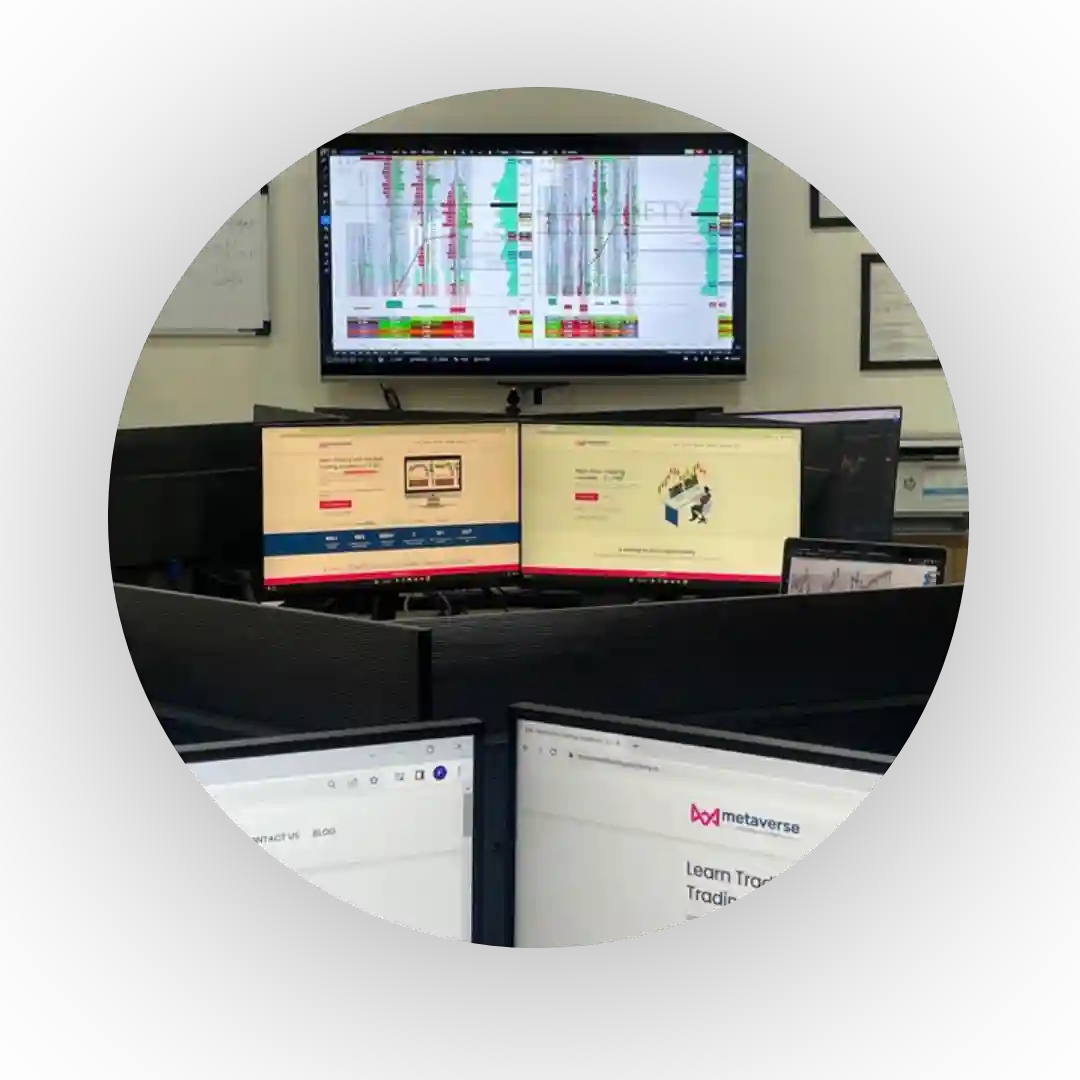
Metaverse Trading Academy is best trading academy in india to learn stock trading using order flow, market profile, volume profile, option chain etc.
Rajkot, Gujarat, India


What is Upper Circuit and Lower Circuit, and why do traders fear it?
Upper Circuit and Lower Circuit decide how far a stock can move daily. These limits exist on every stock listed on NSE and BSE. They protect the market from sudden, irrational price swings. In simple terms, a price band sets the maximum rise and fall allowed daily. Once a stock touches either edge, trading freezes at that price. New traders should also study why new traders are losing money early on.
Quick answer: Upper circuit means a stock hit its highest price today. Lower circuit means it hit its lowest price today. Both happen due to price band rules set by exchanges.
Upper circuit meaning is straightforward once you see it visually. The stock price rises until it touches its daily ceiling. After that point, no more buying is allowed beyond that price.

Sellers exist, but very few are willing to sell. Most holders expect the price to rise further tomorrow. This creates a one sided order book. Buyers queue up, but trades barely execute. Learning the difference between trading and investing helps clarify this point.
Lower circuit meaning works in the opposite direction. The price falls until it hits its lowest permitted level. Sellers dominate the order book completely. Buyers vanish because confidence in the stock collapses. Your sell order may sit pending for days without execution.
This is one of the harshest liquidity risk situations in stock markets. New traders often confuse this with normal price correction. Understanding risk management in trading helps you avoid such painful surprises.
A price band in stock market is simply a daily movement limit. Exchanges fix this limit using the previous closing price. Common bands are two percent, five percent, ten percent, and twenty percent. The exact band depends on the stock category and liquidity.
NSE price band and BSE price band rules differ slightly in execution. Highly liquid, frequently traded stocks usually carry tighter bands. Smaller, thinly traded stocks often carry wider bands. This circuit limit in stock market structure prevents extreme single day shocks.
NSE price band explained simply means the exchange sets daily limits per stock. These limits appear in the market depth window before you trade. NSE revises bands periodically based on volatility and surveillance actions. Stocks under surveillance often get tighter bands suddenly. Always check current limits instead of assuming yesterday’s band.
BSE price band explained works on a similar foundation as NSE. The exchange applies percentage based limits using daily closing prices. BSE also applies separate weekly or monthly bands for some scrips. This is part of stricter stock market circuit filter monitoring. Always verify your stock’s specific band before placing intraday trades.
A stock market circuit filter applies to individual stocks every single day. A circuit breaker in stock market, however, works differently. Circuit breakers halt the entire market, not one stock. This triggers when benchmark indices like Nifty or Sensex crash sharply.

Both mechanisms aim to control panic and excess volatility. Stock market volatility often spreads quickly across related sectors and indices too.
Why stocks hit upper circuit usually comes down to strong demand. Positive news, earnings beats, or sector rallies often trigger this. Sometimes the reason is purely speculative buying interest. Operator driven stocks frequently show repeated upper circuit moves.
Genuine demand and artificial pumping can look identical on charts. Learning how to select best stocks for trading helps you avoid chasing noise.
Why stocks hit lower circuit often relates to bad news or panic. Weak earnings, fraud allegations, or regulatory action can trigger this fast. Liquidity dries up instantly once panic selling begins. Even fundamentally decent stocks can fall this way temporarily.
Negative sentiment spreads quickly through social media and trading forums. Avoiding panic decisions ties closely to trading psychology and emotional discipline.
How upper circuit works can be explained in simple steps.
This pattern repeats across upper circuit stock movements often.
How lower circuit works follows a mirrored sequence of events.
This is exactly how traders get trapped in lower circuit situations. Your capital stays locked with no exit available.
What happens when a stock hits upper circuit affects both holders and watchers. Holders feel confident, since paper profits keep growing visually.

But execution becomes difficult since sellers are scarce. New buyers cannot enter even with strong conviction. This creates frustration despite the bullish looking chart.
What happens when a stock hits lower circuit is far more stressful. Holders watch their capital shrink without any exit option. Panic builds quickly as the stock remains frozen. Many traders check news repeatedly, hoping for quick recovery.
This emotional spiral often leads to poor decisions later. Improving discipline through discipline in trading practices reduces this stress significantly.
Can I buy stocks in upper circuit is a common beginner question. Technically yes, you can place a buy order. However, execution depends entirely on available sellers. If none exist, your order simply queues. Many traders wait hours without any fill happening.
Can I sell stocks in lower circuit follows similar logic in reverse. You can place the sell order anytime.
But execution needs a willing buyer at that price. In severe panic situations, buyers stay completely absent. This is the core liquidity risk in stocks traders must respect.
How traders get trapped in upper circuit usually starts with greed. Traders buy expecting another big rally tomorrow. But operator driven stocks often reverse suddenly without warning. Once selling begins, there are no buyers left.
The trapped trader then faces consecutive lower circuits painfully. Learning how to overcome FOMO and revenge trading prevents this exact mistake.
How traders get trapped in lower circuit happens during sharp crashes. Traders hold on, hoping for a quick bounce back.

Instead, the stock keeps hitting lower circuit repeatedly. Capital gets locked for days or even weeks. Exit becomes nearly impossible until panic finally settles down.
How to avoid circuit trap in stocks starts with proper research. Avoid stocks with thin trading volumes and unclear fundamentals.Check delivery percentage and free float before entering any trade. Avoid blindly following social media stock tips.
Always size your position considering worst case scenarios. Studying why most traders fail reveals patterns behind most circuit traps.
Trading stocks in upper circuit needs extra caution and patience. Avoid chasing stocks already locked multiple sessions consecutively.
Check news triggers before assuming pure momentum continues. Use smaller position sizes for such speculative trades. Never assume liquidity will return whenever you need it.
Trading stocks in lower circuit demands strict risk control measures. Avoid catching falling stocks without proper research first.
Wait for stabilization signals before considering any entry. Confirm the company’s fundamentals are genuinely strong first. Reading about risk reward ratio in trading helps size such trades safely.
Penny stocks upper circuit moves often look exciting on social media. Small price increases create large percentage gains quickly.
But these stocks usually have very low free float. Reading FII and DII flow data also reveals genuine institutional interest patterns. Liquidity disappears just as fast once sentiment shifts.
Operator driven stocks show repeated, suspicious circuit patterns over time. Different types of traders in the stock market react differently to such patterns.

Stock manipulation signs include unusual promoter activity and vague disclosures. Price movements with no fundamental explanation deserve extra scrutiny. Always cross check using fundamental analysis before trusting momentum alone.
Intraday trading risks increase significantly near circuit limits. Stop losses cannot execute once a stock freezes completely.
This means your risk becomes technically unlimited during such freezes. Many traders learn this lesson only after losses. Understanding intraday options trading strategy helps build safer habits overall.
Liquidity risk in stocks becomes extreme during circuit freezes. Your money gets locked regardless of your original strategy.
This is especially dangerous for leveraged or borrowed positions. Margin calls can occur even without any execution possible. Reviewing trading charges in India also helps you understand hidden cost impacts.
Trading psychology plays a massive role during circuit events. Fear and greed both intensify when trades feel stuck.
Patience becomes essential rather than panic driven decisions. Avoid checking prices repeatedly, since it increases anxiety levels. Building mental resilience through proper trading mentorship programs helps long term consistency.
Strong risk management in trading reduces circuit related losses significantly. Diversify your holdings instead of concentrating heavily in one stock.
Avoid excessive leverage on illiquid or speculative stocks. Always check historical circuit frequency before entering new positions. Beginners should also explore free paper trading apps before risking real capital.
New traders often ignore circuit mechanics until facing real losses. Understanding price bands early prevents avoidable, costly mistakes later.

This knowledge complements broader market education effectively. Pairing it with technical analysis basics builds a stronger trading foundation. Structured learning through NISM certification also strengthens your overall market understanding.
According to SEBI’s official investor education resources, circuit filters exist primarily for investor protection. Exchanges like NSE India publish daily updated price bands publicly. Reviewing BSE’s market data section regularly helps confirm current circuit limits accurately. Many traders also follow Moneycontrol’s market coverage for daily circuit stock lists. International readers can compare mechanisms using Investopedia’s explanation of circuit breakers for added context.
Upper circuit means a stock reached its maximum price for the trading day. Buying continues, but sellers become extremely scarce, freezing further movement until fresh selling interest returns to market.
Lower circuit means a stock hit its minimum price for the trading day. Selling continues, but buyers completely disappear, freezing the price until renewed buying interest finally appears in market.
Yes, you can usually cancel your pending orders during a circuit lock. However, actual execution remains impossible until normal trading resumes again with willing counterparties available on the other side.
Check the market depth window on your trading platform before placing any order today. NSE and BSE also publish daily updated circuit limits on their official websites for quick verification.
No, circuit limits vary widely by stock category, liquidity, and overall volatility levels. Exchanges typically assign two, five, ten, or even twenty percent bands depending on each stock’s specific classification.
Upper Circuit and Lower Circuit shape daily price movement boundaries. They protect markets but can trap unprepared traders quickly.
Understanding price bands, liquidity risk, and trading psychology matters greatly. Always research before chasing momentum driven circuit stocks blindly. Disciplined risk management remains your strongest protection against circuit traps.
Explore our trading training programs and structured trading plans for consistent growth.


Disclaimer: Investing/Trading in the stock market is subject to market risks, and there is no assurance or guarantee of returns—neither the principal nor the appreciation of the investments. The content/education/training provided by Metaverse Trading Academy, its institute, mentors, trainers, representatives, or their assigns is solely for general interest, educational purposes, and the reader’s information. All participants are requested to seek independent expert opinions before acting on anything mentioned in this course/program. We are not liable or responsible for any decisions made by the participant solely based on the information provided here. All information/views/opinions shared in the course/program are our interpretation for educational understanding only, and we cannot be held responsible for any miscommunication, misinformation, misunderstanding, or any actions taken by an individual or group based on the course/program. By enrolling in and accessing the program/course, you accept this “Disclaimer,” without limitation or qualification. Upon viewing this disclaimer, you understand and acknowledge that there is a very high degree of risk involved if any information is misinterpreted, misused, or applied without proper risk management and independent judgment. As stipulated by law, Metaverse Trading Academy cannot and does not make any guarantees about your ability to get results or earn money with any ideas, information, tools, indicators, systems, or strategies from the course/program. The participant should understand that all ideas, information, tools, strategies, examples, and market discussions shared during the course/program are for educational and informational purposes only. Metaverse Trading Academy, its founders, mentors, trainers, management, and team members are neither responsible nor liable for any losses, damages, or consequences resulting from investments or trading activities. You alone are fully responsible and accountable for your decisions, actions, trades, investments, and results in life. By registering here, enrolling in any program, or accessing any material, you agree not to attempt to hold Metaverse Trading Academy, its founders, mentors, trainers, management, or team liable for your decisions, actions, or results, at any time, under any circumstance.