Why do so many option sellers sell the at-the-money straddle on quiet days?
Because the at-the-money call and put carry the most time value of any strikes. If the market stays quiet, that time value melts away and the seller keeps it. The short straddle is the purest way to sell that premium. It is also one of the riskiest option strategies if it is not managed and hedged properly.
This guide explains the short straddle with a Nifty example. You will learn how it works, its breakevens, how it compares with a short strangle, how to hedge it and when to avoid it. If you are new to selling options, start with our comparison of option buying vs option selling.
What Is a Short Straddle?
A short straddle sells one call and one put at the same strike, usually at the money, with the same expiry. With Nifty at 24,000, you might sell the 24,000 call at 165 and the 24,000 put at 160, collecting 325 points in total.
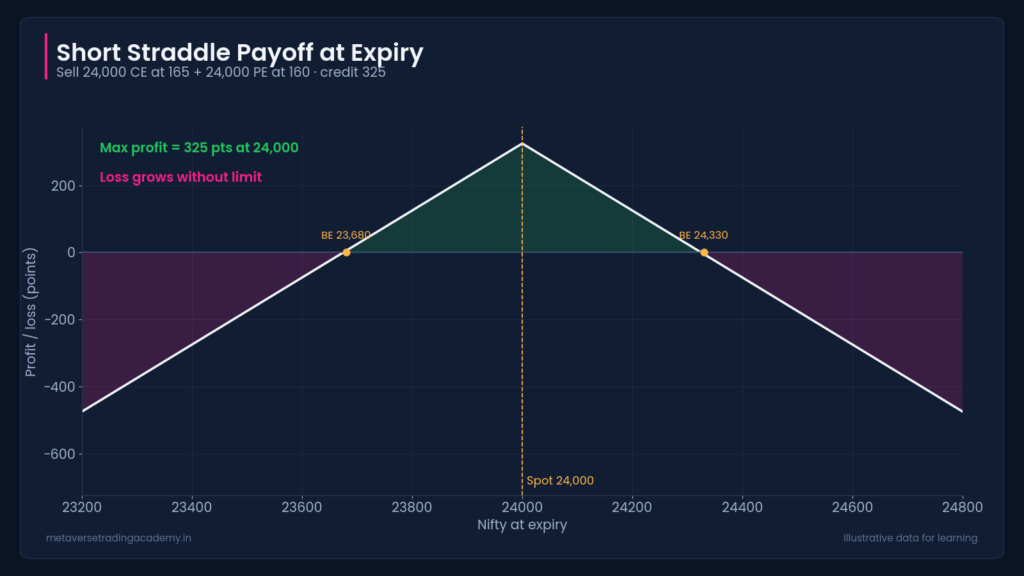
- Maximum profit: the total premium, 325 points, if Nifty expires exactly at 24,000.
- Upper breakeven: 24,000 + 325 = 24,325.
- Lower breakeven: 24,000 – 325 = 23,675.
- Maximum loss: unlimited above the upper breakeven and very large below the lower one.
Premiums are illustrative. Real values depend on implied volatility, time to expiry and market conditions.
How a Short Straddle Makes Money
The seller earns from two sources. Time decay, or theta, reduces both premiums every day. A fall in implied volatility, measured by vega, reduces them further. Our guides to option Greeks and implied volatility explain both.
The enemy is movement. The seller is short gamma, so every move away from the strike creates losses that grow faster as the move extends. Near expiry, gamma is highest and small moves create large swings.
The Straddle Price Is the Market’s Expected Move
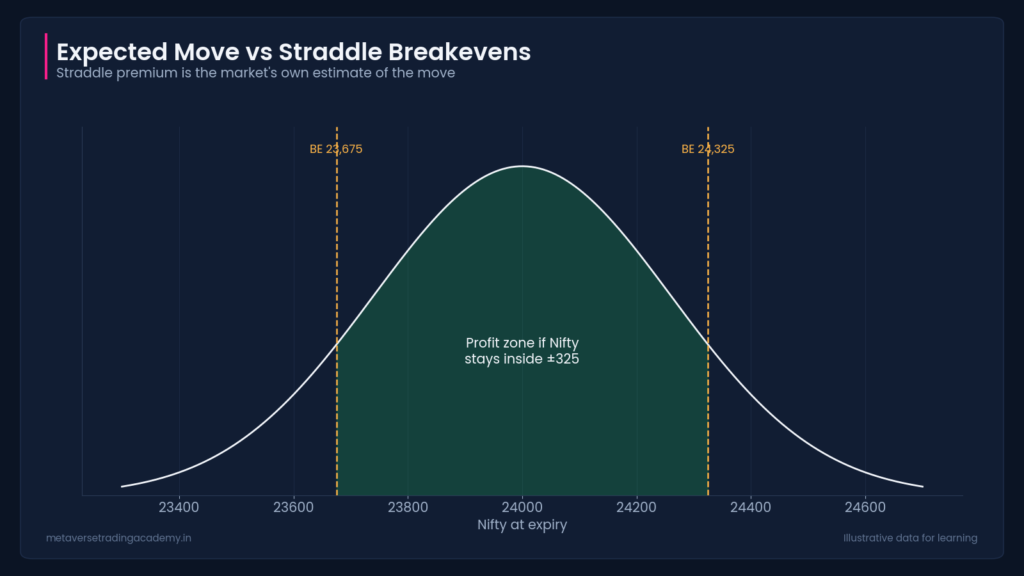
The at-the-money straddle price is a quick estimate of how far the market expects price to move by expiry. When you sell it, you are betting that the actual move will be smaller than the market’s estimate. Sellers win over time only when implied volatility is, on average, higher than the volatility that actually follows.
Short Straddle vs Short Strangle
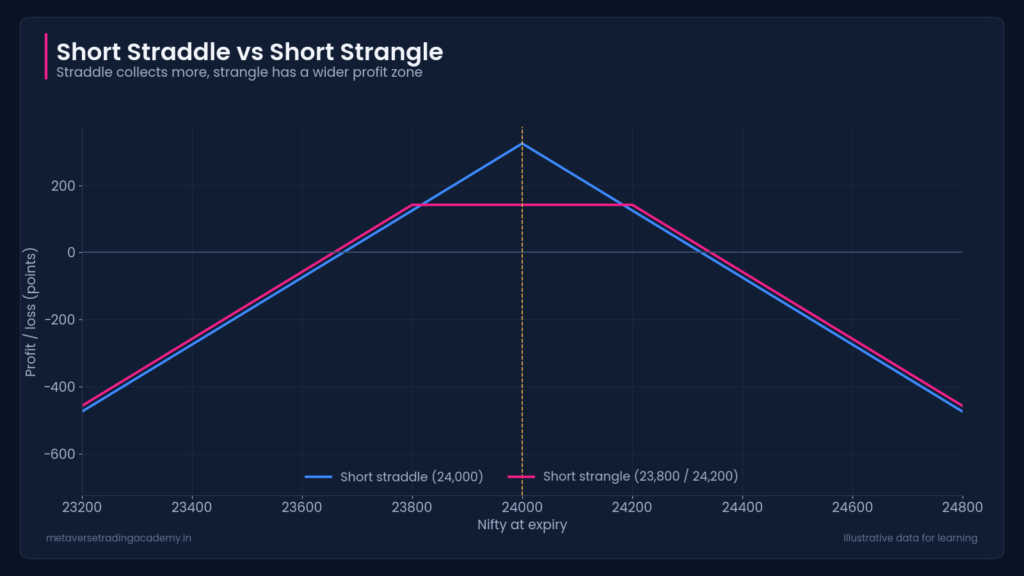
| Feature | Short straddle | Short strangle |
|---|---|---|
| Strikes | Same, at the money | Different, out of the money |
| Premium | Higher | Lower |
| Profit zone | Narrower | Wider |
| Sensitivity to small moves | High | Lower |
| Risk | Unlimited | Unlimited |
Hedging a Short Straddle: The Iron Butterfly
The simplest way to control a short straddle’s risk is to buy protective wings: an out-of-the-money put and an out-of-the-money call. This turns the position into an iron butterfly with a known maximum loss.
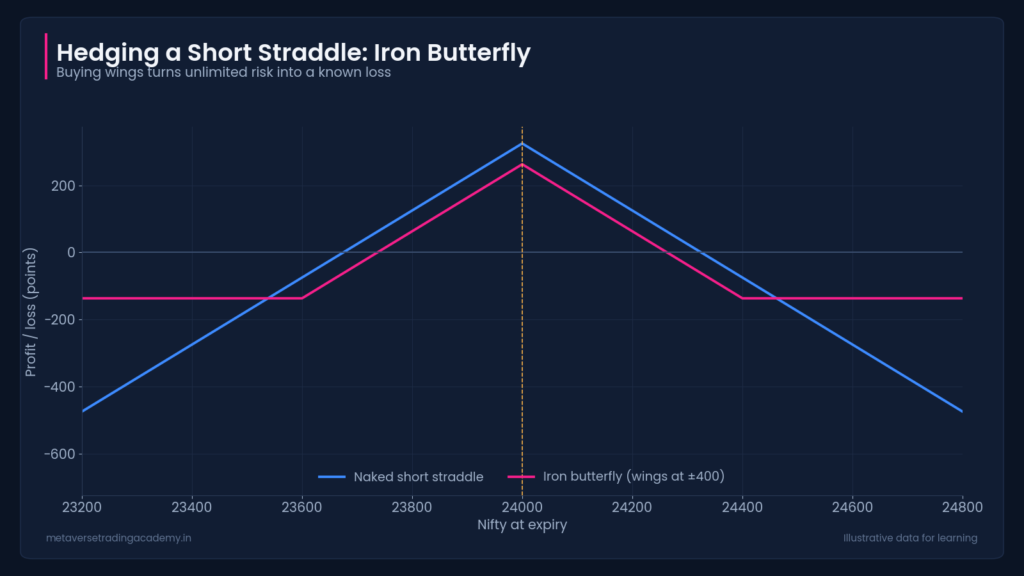
The wings reduce the credit, but they protect you from gap moves and usually lower the margin needed. For a wider, range-based version of the same idea, see our guide to the iron condor strategy, and check max pain and open interest to see where option positions cluster.
Managing a Short Straddle
- Combined premium stop: exit if the total premium rises by a fixed percentage, such as 25 to 50 percent.
- Price stop: exit if Nifty breaks a key level beyond the range.
- Profit target: many sellers book profit after capturing a planned share of the premium.
- Adjust: roll the straddle to the new at-the-money strike or add wings when price moves.
- Time: avoid sitting in a naked straddle through the last hours of expiry without a hedge.
Watch the market regime. In positive gamma conditions price tends to rotate, which suits straddle sellers. In negative gamma, moves accelerate. Our guide to gamma exposure (GEX) explains the difference.
When to Avoid a Short Straddle
- Before scheduled events: results, RBI policy, the Union Budget or major global data. See our guide to earnings season trading.
- When India VIX is unusually low, because the premium does not pay enough for the risk. See India VIX and volatility.
- After a breakout from a range, when trend days are more likely.
- When you cannot monitor the position.
Option selling carries real risk. SEBI’s studies of the futures and options segment found that around 9 in 10 individual traders made net losses in FY22 and again in FY24. Read the findings on the SEBI website, and size positions from the loss you can accept. Our risk management guide shows how.
Short Straddle Checklist
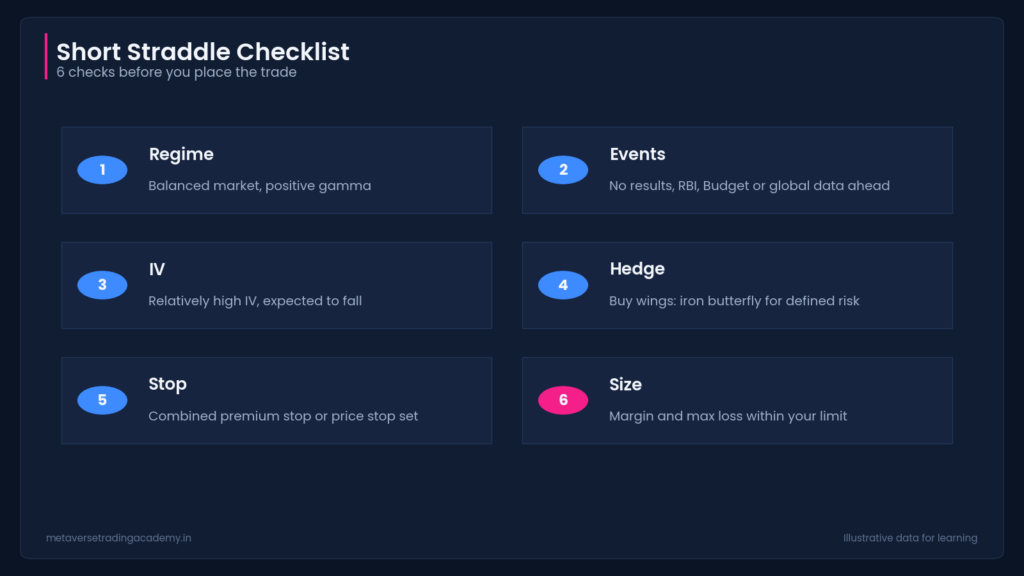
Practise first on a demo account, and include brokerage and statutory charges in your plan. See trading charges in India.
Common Short Straddle Mistakes
- Selling naked straddles without any hedge or stop.
- Selling before major events because the premium looks attractive.
- Averaging into losing positions.
- Using too much margin and leaving no room for adjustments.
- Ignoring the regime and selling into a trending market.
Straddles Inside the CLBS Framework
In the CLBS V18 framework taught at Metaverse Trading Academy, selling at-the-money premium is a hedged seller route in the Strategy step. It is only considered when Context shows a balanced auction, volatility is rich and no event risk sits before expiry, and it is always hedged. Every idea passes PM-CORE and ends as Permission, Restriction or Stand-Down. See the free CLBS V18 brochure or explore our trading plans.
Frequently Asked Questions
A short straddle sells an at-the-money call and an at-the-money put with the same strike and expiry. The trader collects both premiums and profits if the underlying stays close to the strike until expiry.
The loss is unlimited on the upside and very large on the downside, because the trader is short both a call and a put. That is why many traders hedge it by buying wings, which turns it into an iron butterfly with a defined maximum loss.
Add the total premium collected to the strike for the upper breakeven and subtract it for the lower breakeven. Selling the 24,000 straddle for 325 points gives breakevens of 24,325 and 23,675.
A short straddle collects more premium but has a narrower profit zone. A short strangle sells out-of-the-money options, collects less premium and has a wider profit zone. Both carry large risk unless hedged.
Short straddles suit balanced, range-bound markets with relatively high implied volatility and no major events before expiry. Avoid them before results, RBI policy, the Union Budget or major global data.
Margin depends on the exchange's SPAN and exposure requirements, the lot size and volatility. Naked straddles need much higher margin than hedged structures such as an iron butterfly. Check your broker's margin calculator before trading.
Conclusion
The short straddle sells the richest premium in the option chain and profits when the market stays quiet. That reward comes with large risk. Sell only in balanced, event-free conditions, hedge with wings, set stops before entry and size from the loss you can accept.
This article is for education only. It is not investment advice or a trade recommendation. Trading in derivatives involves risk of loss.
Ready to trade options with a professional process? Visit Metaverse Trading Academy and start learning live today.

Vikas Gahlot
NISM-certified trader, technical analyst, and founder of Metaverse Trading Academy. With more than 10 years of experience in stock market trading and technical analysis, I have trained over 10,000 students across India through online and offline trading programs focused on intraday trading, swing trading, futures & options, and risk management.
More guides by Vikas Gahlot →