You are bullish on Nifty, but option premiums look expensive. What do you do?
Buying a call outright means paying full premium and fighting time decay every day. Many traders lose money even when they are right on direction. The bull call spread solves much of this. It lowers your cost, lowers your breakeven and cuts the damage from time decay, in exchange for capping your upside at a target you choose.
This guide explains the bull call spread step by step with a Nifty example. You will learn how to build it, how to pick strikes, how it compares with buying a call and how to manage it. If option pricing is new to you, read our guide to option Greeks first.
What Is a Bull Call Spread?
A bull call spread has two legs with the same expiry: buy a call at a lower strike and sell a call at a higher strike. It is also called a debit call spread or a vertical call spread.
| Leg | Action | Strike | Premium |
|---|---|---|---|
| Long call | Buy | 24,000 CE | 165 |
| Short call | Sell | 24,300 CE | 60 |
| Net | Debit | 105 |
Profit, Loss and Breakeven
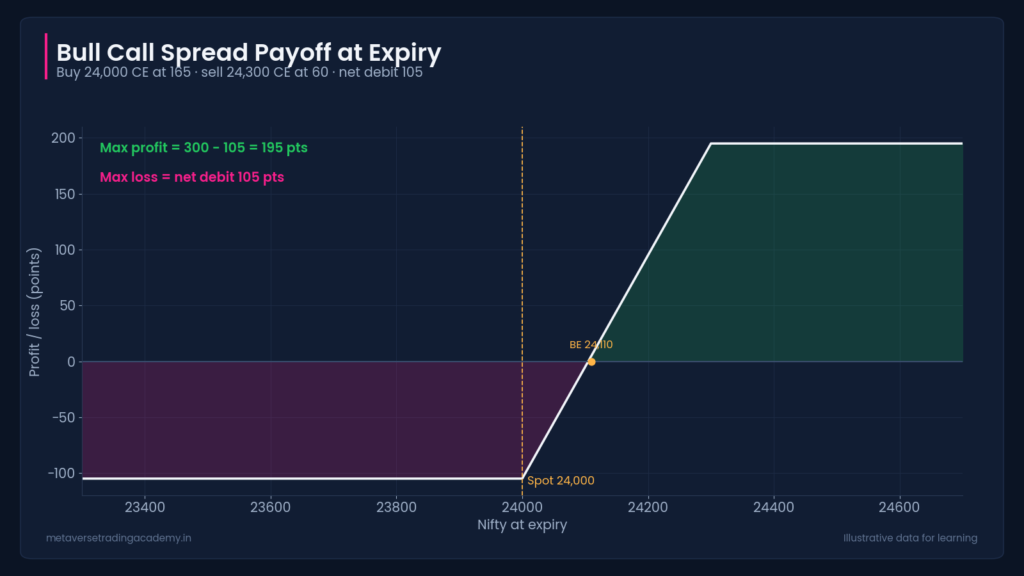
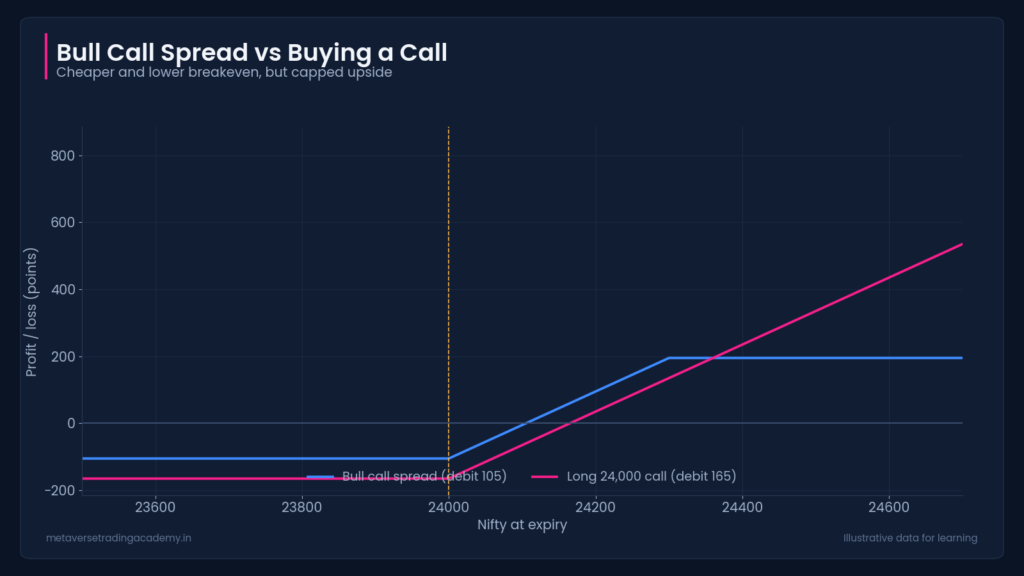
- Maximum loss: the net debit, 105 points, if Nifty expires at or below 24,000.
- Maximum profit: strike difference minus debit, 300 – 105 = 195 points, if Nifty expires at or above 24,300.
- Breakeven: lower strike plus debit, 24,000 + 105 = 24,105.
- Reward to risk: 195 to 105, or about 1.9 to 1.
Premiums here are illustrative. Real prices depend on volatility, time to expiry and where Nifty is trading.
Bull Call Spread vs Buying a Call
| Feature | Long 24,000 call | Bull call spread |
|---|---|---|
| Cost | 165 | 105 |
| Breakeven | 24,165 | 24,105 |
| Maximum profit | Unlimited | 195 |
| Maximum loss | 165 | 105 |
| Time decay | Higher | Lower |
| Effect of falling IV | Higher | Lower |
The spread wins when Nifty moves up moderately, which is the most common kind of bullish move. The single call only wins when the move is large enough to go well past the short strike.
Why Time Decay Hurts Less
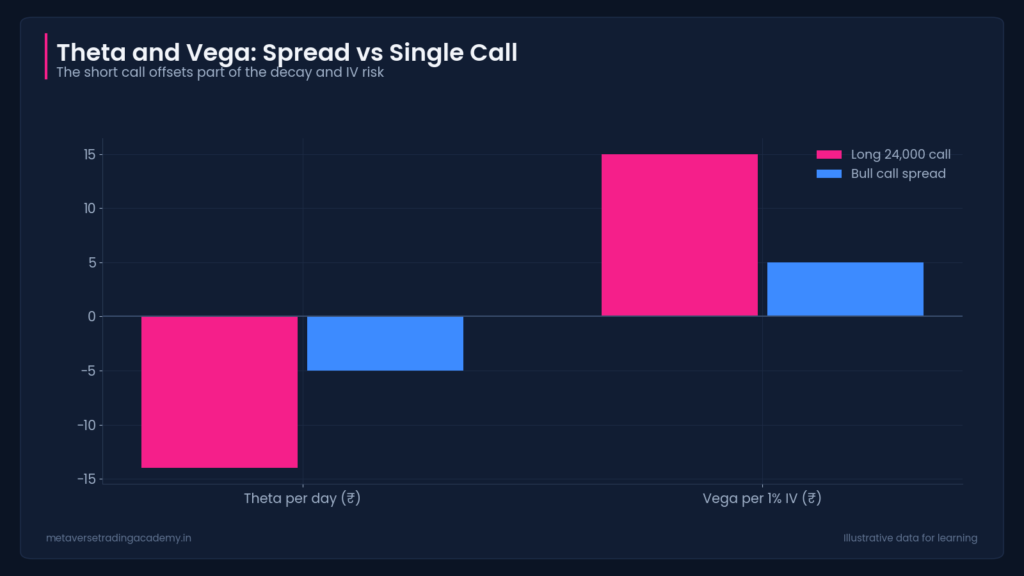
The short call earns time decay while the long call loses it, so the net theta is much smaller. The same applies to vega: a fall in implied volatility hurts the spread far less. This makes spreads attractive when implied volatility is high and buying options outright is expensive.
How to Choose Bull Call Spread Strikes
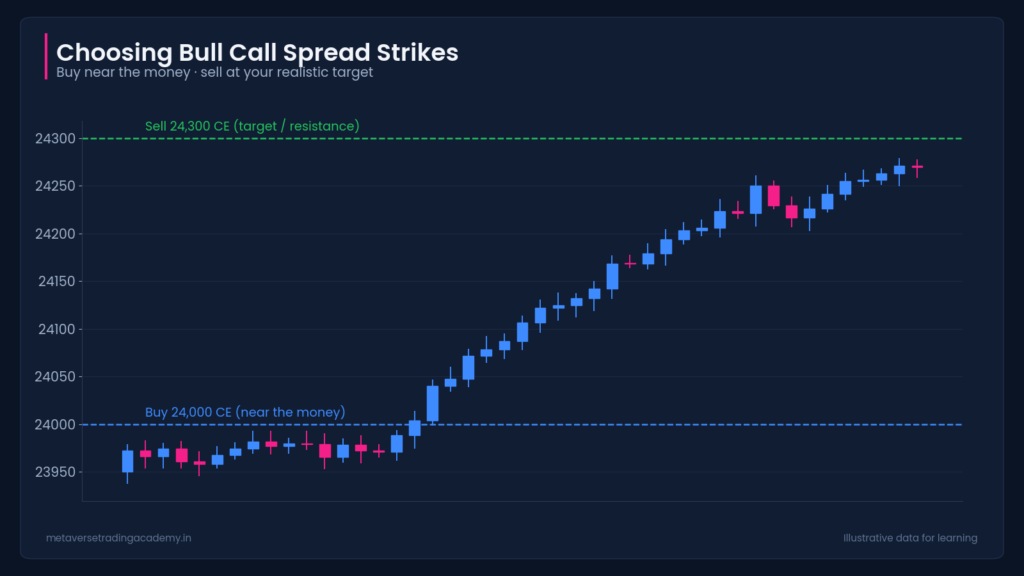
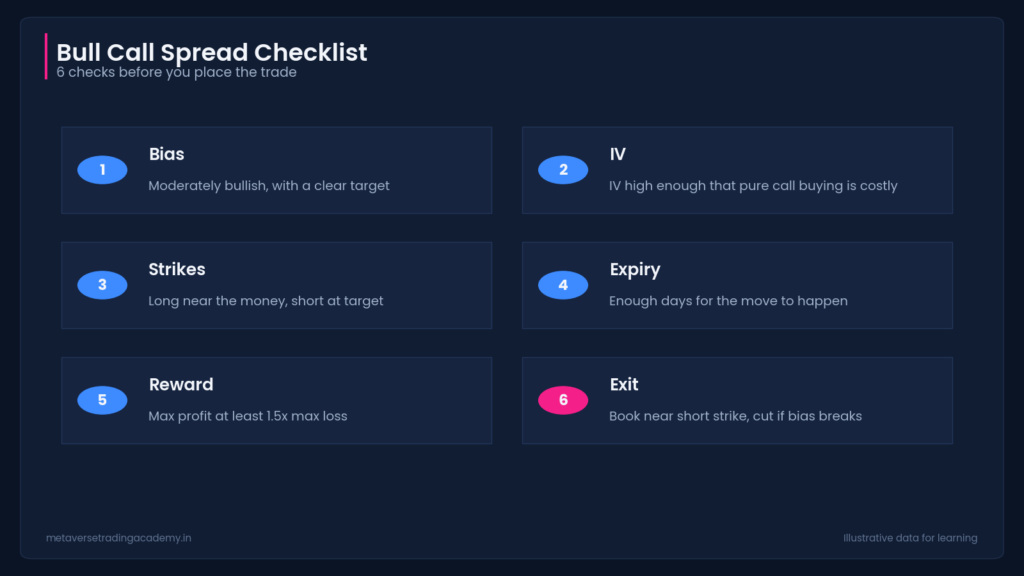
- Long strike: at or near the money, so the position responds to price quickly.
- Short strike: at your realistic target, such as a resistance level or heavy call open interest. See our open interest guide.
- Width: wider spreads give more profit potential but cost more.
- Expiry: give the move enough time. Very short expiries leave little room for error.
- Reward: aim for a maximum profit of at least 1.5 times the maximum loss.
Targets work best when they come from the chart. Use support and resistance, the point of control or a Market Profile value area edge to set the short strike.
When to Use a Bull Call Spread
- You are moderately bullish, not expecting an explosive rally.
- Implied volatility is high, making single calls expensive.
- You have a clear target level for the move.
- You want defined risk with a lower cost than buying a call.
The bearish mirror is the bear put spread: buy a higher put and sell a lower put. A credit-based bullish alternative is the bull put spread. Our guide to option buying vs selling explains how debit and credit strategies differ.
Managing a Bull Call Spread
- Exit when price reaches the short strike or when 70 to 80 percent of maximum profit is captured.
- Cut the trade if your bullish reason breaks, such as a close back below a key level.
- Avoid holding into expiry when price sits near a strike, because the outcome can swing sharply.
- Close both legs together to avoid being left with a naked short call.
Size every position so the maximum loss is an amount you are comfortable losing. Our risk management guide explains how, and our risk reward ratio guide shows how to judge a setup.
Bull Call Spread Checklist
Practise on a demo account first, and account for brokerage on both legs. See trading charges in India.
Common Bull Call Spread Mistakes
- Choosing a short strike far beyond any realistic target.
- Picking expiries too short for the move you expect.
- Using spreads when the view is not actually bullish.
- Legging in and out separately and taking unplanned risk.
- Ignoring liquidity, which widens costs.
Spreads Inside the CLBS Framework
In the CLBS V18 framework taught at Metaverse Trading Academy, the bull call spread is one of the defined-risk buyer routes in the Strategy step. It is chosen when Context and Levels support a move to a specific target, and when volatility makes buying a single option inefficient. Every idea ends as Permission, Restriction or Stand-Down. See the free CLBS V18 brochure or explore our trading plans.
Frequently Asked Questions
A bull call spread is a two-leg options strategy for a moderately bullish view. You buy a call at a lower strike and sell a call at a higher strike with the same expiry. The sold call reduces the cost, and both profit and loss are limited.
Maximum loss is the net debit paid. Maximum profit is the difference between the strikes minus the net debit. In our example, buying the 24,000 call at 165 and selling the 24,300 call at 60 gives a 105 debit, a maximum loss of 105 and a maximum profit of 195 points.
Breakeven at expiry equals the lower strike plus the net debit. With a 24,000 long call and a 105 debit, breakeven is 24,105.
It is cheaper, has a lower breakeven and suffers less from time decay and falling implied volatility. The trade-off is capped profit. If you expect a very large move, a single call can earn more. If you expect a moderate move to a target, the spread is usually more efficient.
Many traders exit when price reaches the short strike or when most of the maximum profit is captured. Exit early if your bullish reason breaks, for example if price falls back below a key level.
A bull call spread is a debit strategy. You pay a net premium to enter. Its credit-based alternative is the bull put spread, which sells a higher put and buys a lower put.
Conclusion
The bull call spread is the practical way to express a moderately bullish view. It costs less than buying a call, breaks even sooner and suffers less from time decay and falling volatility. Choose the short strike at a real target, size from the debit and exit with a plan.
This article is for education only. It is not investment advice or a trade recommendation. Trading in derivatives involves risk of loss.
Ready to trade options with a professional process? Visit Metaverse Trading Academy and start learning live today.

Vikas Gahlot
NISM-certified trader, technical analyst, and founder of Metaverse Trading Academy. With more than 10 years of experience in stock market trading and technical analysis, I have trained over 10,000 students across India through online and offline trading programs focused on intraday trading, swing trading, futures & options, and risk management.
More guides by Vikas Gahlot →