
What if you could profit when Nifty does almost nothing all week?
Most of the time markets do not trend. They rotate inside a range. The iron condor strategy is built for exactly those days. It collects option premium when price stays inside a zone, and it limits the damage when price breaks out. That combination of income and defined risk makes it one of the most widely taught option selling strategies.
This guide explains the iron condor in simple words with a Nifty example. You will learn how it is built, how to pick strikes, how to manage and adjust it, and when to avoid it. If you are new to selling options, first read our comparison of option buying vs option selling.
What Is an Iron Condor?
An iron condor combines two credit spreads: a bull put spread below the market and a bear call spread above it. It has four legs, all with the same expiry.
| Leg | Action | Example strike | Premium |
|---|---|---|---|
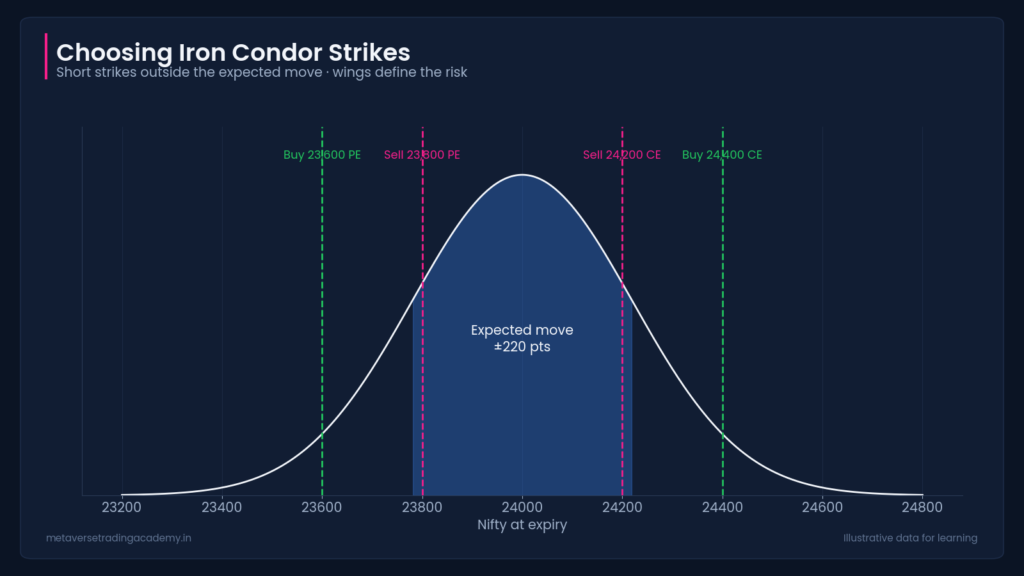
| Long put (protection) | Buy | 23,600 PE | 22 |
| Short put | Sell | 23,800 PE | 48 |
| Short call | Sell | 24,200 CE | 46 |
| Long call (protection) | Buy | 24,400 CE | 20 |
With Nifty at 24,000, you receive 48 + 46 = 94 and pay 22 + 20 = 42. Your net credit is 52 points. The bought options are the wings. They cost you some premium, but they put a hard limit on your loss.

Profit, Loss and Breakevens
- Maximum profit: the net credit, 52 points, if Nifty expires between 23,800 and 24,200.
- Maximum loss: wing width minus credit, 200 – 52 = 148 points.
- Lower breakeven: short put minus credit, 23,800 – 52 = 23,748.
- Upper breakeven: short call plus credit, 24,200 + 52 = 24,252.
These numbers are illustrative. Real premiums change every minute with price, time and volatility.
Why the Iron Condor Works
An iron condor earns money from two forces. Time decay, or theta, erodes the premium you sold every day. Falling implied volatility, measured by vega, also reduces the premium. Our guides to option Greeks and implied volatility explain both in detail.
It works best when the market is balanced. In positive gamma conditions, dealer hedging tends to pull price back toward the middle of the range. Learn to recognise those days in our guide to gamma exposure (GEX).
How to Choose Iron Condor Strikes
Strike selection decides almost everything about an iron condor. Short strikes too close collect good premium but get tested often. Short strikes too far feel safe but pay very little.
- Calculate the expected move from implied volatility for your expiry.
- Place short strikes at or just outside that expected move.
- Check the option chain for heavy open interest walls near your short strikes. See our open interest guide.
- Many traders choose short strikes with a delta of about 0.15 to 0.25.
- Choose wing width based on the maximum loss you can accept.
Iron Condor vs Short Strangle
A short strangle sells the same two options without buying wings. It collects more premium, but its loss has no limit if the market makes a big move.

| Feature | Iron condor | Short strangle |
|---|---|---|
| Legs | 4 | 2 |
| Credit | Lower | Higher |
| Maximum loss | Limited | Unlimited |
| Margin | Usually lower because of hedges | Usually much higher |
| Gap risk | Capped by wings | Full exposure |
Managing and Adjusting an Iron Condor
An iron condor is not a set-and-forget trade. Write your management rules before entry.

- Take profit early: many traders close at 50 to 60 percent of the maximum credit instead of waiting for expiry.
- Roll the untested side: if price moves toward the call, roll the put spread closer to collect extra credit.
- Close the tested side: if price breaks a short strike with momentum, exit that spread.
- Respect expiry week: gamma rises sharply near expiry, so small moves create big swings in profit and loss.
When to Avoid an Iron Condor
- Before scheduled events such as results, RBI policy or the Union Budget. Read our guide to earnings season trading.
- When India VIX is very low, because premium is thin. See India VIX and volatility.
- On clear trend days or after a range breakout.
- When you cannot watch the position during market hours.
Option selling is not easy money. SEBI’s studies of the futures and options segment found that around 9 in 10 individual traders made net losses in FY22 and again in FY24. Read the findings on the SEBI website, and never trade size you cannot afford to lose. Our risk management guide explains how to size positions.
Iron Condor Checklist
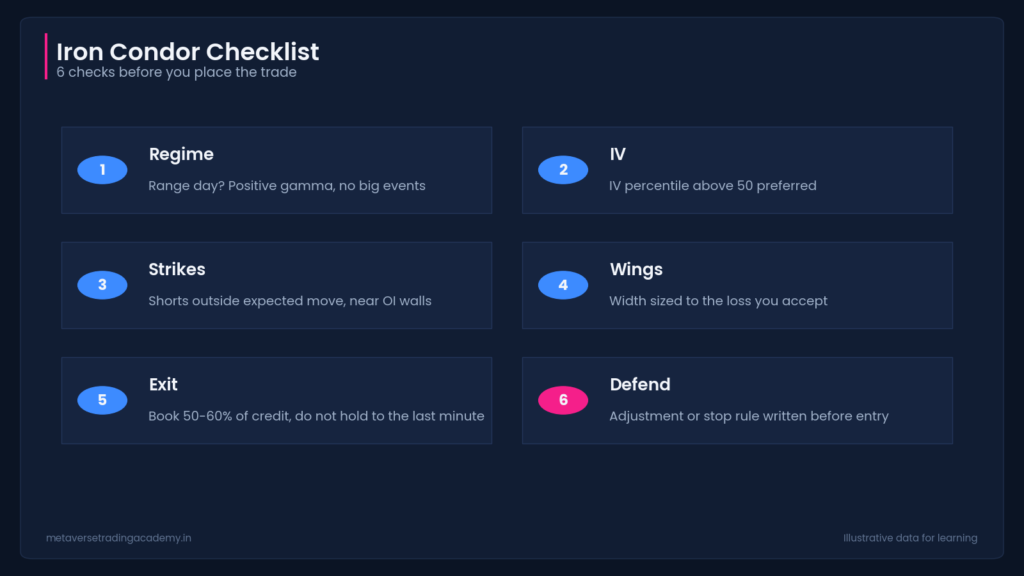
Remember costs. An iron condor has four legs, so brokerage and charges add up. Review trading charges in India before trading it often.
Iron Condors Inside the CLBS Framework
In the CLBS V18 framework taught at Metaverse Trading Academy, an iron condor is one of the hedged seller routes in the Strategy step. It is only considered when Context shows a balanced auction, Levels show clear range edges and volatility supports selling. Every idea passes PM-CORE and ends as Permission, Restriction or Stand-Down. See the free CLBS V18 brochure or explore our trading plans.
Frequently Asked Questions
An iron condor is a four-leg options strategy. You sell an out-of-the-money put and an out-of-the-money call, and buy a further out-of-the-money put and call as protection. You collect a net credit and profit if the underlying stays between the two short strikes until expiry.
Maximum profit is the net credit received. Maximum loss is the width of one wing minus the net credit. For example, with 200-point wings and a 52-point credit, the maximum loss is 148 points per unit.
Iron condors suit range-bound markets with relatively high implied volatility and no major scheduled events before expiry. They struggle in strong trending markets or around results, policy decisions and budgets.
An iron condor has defined risk because the long wings cap the loss. A short strangle collects more premium but has unlimited risk. Iron condors also usually need less margin, which makes them more practical for most traders.
Common adjustments include rolling the untested side closer to the price to collect more credit, rolling the whole position, or closing the threatened side. The adjustment rule should be written before you enter the trade.
There is no fixed success rate. Strikes further out of the money win more often but collect less credit and lose more when they fail. What matters is the balance between win rate, average profit and average loss over many trades.
Conclusion
The iron condor turns a quiet market into an opportunity with a known maximum loss. Sell outside the expected move, protect with wings, take profits early and avoid event weeks. Treat it as a risk-managed business, not a guaranteed income machine.
This article is for education only. It is not investment advice or a trade recommendation. Trading in derivatives involves risk of loss.
Ready to trade options with a professional process? Visit Metaverse Trading Academy and start learning live today.

Vikas Gahlot
NISM-certified trader, technical analyst, and founder of Metaverse Trading Academy. With more than 10 years of experience in stock market trading and technical analysis, I have trained over 10,000 students across India through online and offline trading programs focused on intraday trading, swing trading, futures & options, and risk management.
More guides by Vikas Gahlot →