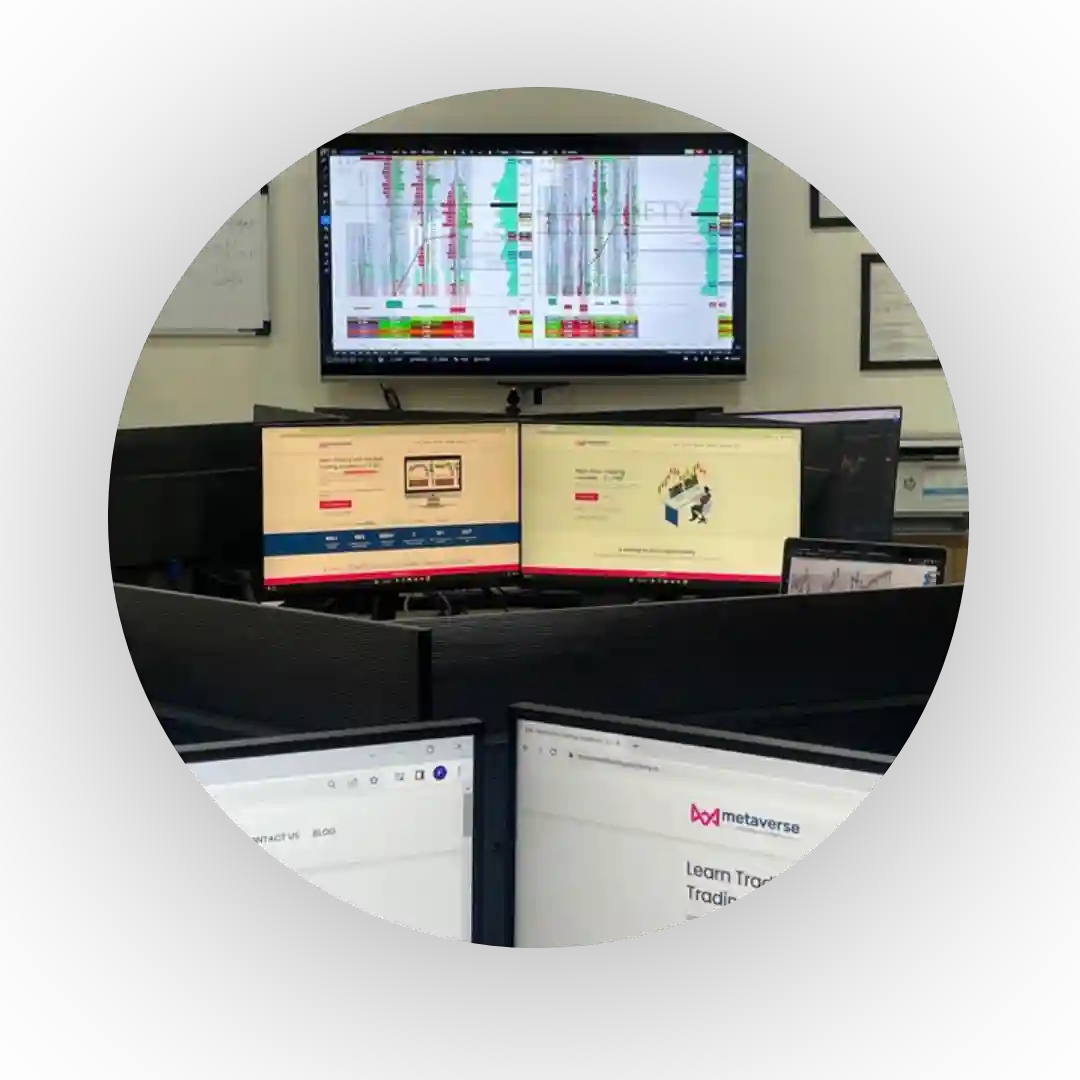
Metaverse Trading Academy is best trading academy in india to learn stock trading using order flow, market profile, volume profile, option chain etc.
Rajkot, Gujarat, India


The rise of AI chatbots and autonomous algorithms in financial markets has ignited a profound debate: will autonomous trading systems eventually replace human traders? In India’s dynamic stock market — with its retail participation, global linkage and regulatory evolution — this question is especially relevant. For aspiring traders and seasoned investors alike, understanding how AI is transforming trading — and where humans still hold the edge — is crucial.
In this article, we explore how AI chatbots and trading-algorithms are changing the game, evaluate whether they might render human traders obsolete, and map out what this means for you in the Indian context. Let’s dive in.

Before we debate replacement, we must clarify what we mean by AI chatbots and autonomous trading.
AI chatbots are conversational agents powered by machine learning and large-language models. In trading, these may act as “advisors” or signal-generators, analysing text/news, answering trader queries, and suggesting trades.
Autonomous trading systems (algorithmic trading, high-frequency trading, reinforcement-learning-based bots) actually execute trades without human intervention.
Key features include:
Yet there are limitations too: they rely on historical data, may struggle with black-swan events, and lack human intuition/experience.
In the Indian context, AI chatbots are increasingly used for brokerage client service, retail advisory, and even algorithmic signals, while autonomous algorithms are more prevalent at institutional levels.
Here’s why autonomous systems are becoming formidable in trading:
For Indian markets (Bombay Stock Exchange, National Stock Exchange of India, derivatives, algorithmic trading platforms), AI adoption is gradually increasing — institutional houses and quant funds are investing in algorithms to stay competitive globally.

Despite the rise of AI chatbots and trading systems, human traders still bring important strengths. Here’s why human traders remain relevant:
Industry voices support this. For example, a major fund manager stated that while AI is useful, replacing human fund-managers entirely is “a fantasy”.
For Indian traders and investors, this means human-centric skills (market understanding, behavioural discipline, story-analysis, risk management) remain highly valuable.
When assessing the future of autonomous trading in India, you need to factor in local market traits:
Thus while AI chatbots and algorithms will play a growing role in India, their path to full replacement of human traders is different from highly automated western markets.

Now to the core question: Will AI replace human traders? The short answer: Not entirely, at least not in the foreseeable future — but the role of human traders will shift significantly. Let’s break it down:
The bottom line: AI chatbots and autonomous trading are powerful tools, but they are unlikely to completely supplant human traders’ strategic and contextual roles in India. The best outcome for many traders is a hybrid model — humans augmented by AI.
For aspiring traders and investors via Metaverse Trading Academy, here are practical strategies:
By combining human strengths with AI tools, Indian traders can position themselves for success rather than obsolescence.

Here’s a look at where things may go — and what Indian traders should watch for:
In short: The future is not about “humans vs. machines” but “humans working with machines, smarter and more agile than ever”.
An AI chatbot in trading is a conversational agent that uses natural‐language processing and machine learning to analyse market data, answer trader questions, generate signals or advise on trade decisions. It does not necessarily execute trades.
Not at this stage. AI chatbots and autonomous systems are amplifying trading capabilities, but human judgement, contextual understanding and oversight remain key—especially in India’s complex market environment.
Chatbots assist with insights, advice and conversation. Autonomous trading systems are algorithms that make and execute trade decisions, often at high speed and with minimal human involvement.
Yes. AI systems may over-fit historical data, fail in novel conditions, lack transparency, and amplify systemic risk if many players use similar models.
Discipline in trading psychology, strong risk management, market-story understanding, ability to interpret and override AI outputs, and staying tuned to Indian market nuances (regulatory, sentiment, behavioural) are essential.
Yes. Indian regulators are likely to publish guidelines around algorithmic trading, AI governance and model-risk. Traders should keep an eye on regulatory developments and ensure any AI-tool they use is transparent and compliant.
Use them for idea generation, news scanning, signal generation, but always apply your own judgement, back-test before relying, understand the logic behind the tool, and never trade purely based on a bot without risk controls.
The rise of AI chatbots and autonomous trading systems is reshaping financial markets — both globally and in India. But rather than signaling the end of human traders, this evolution points to a hybrid future where human insight and machine agility combine.
For traders at the Metaverse Trading Academy, the goal is clear: adapt to the AI-powered era by mastering the tools and preserving your human edge. Traders who embrace AI as a partner — not a threat — and sharpen their unique skills in psychology, strategy and market understanding will thrive.
Autonomous trading is not about humans becoming obsolete — it’s about humans becoming smarter. Let that be your mindset as you build your journey in India’s dynamic markets. Keep learning, stay agile, and trade smart.
Metaverse Trading Academy empowers traders with AI-driven education, trading psychology insights, and practical investment strategies tailored for India’s evolving market landscape.
Learn more at https://metaversetradingacademy.in.


Disclaimer: Investing/Trading in the stock market is subject to market risks, and there is no assurance or guarantee of returns—neither the principal nor the appreciation of the investments. The content/education provided by the institute, mentors, or their assigns is solely for general interest, educational purposes, and the reader’s information. All participants are requested to seek independent expert opinions before acting on anything mentioned in this course/program. We are not liable or responsible for any decisions made by the participant solely based on the information provided here. All information/views/opinions in the course/program are our interpretation, and we cannot be held responsible for any miscommunication, misinformation, or any actions taken by an individual or group based on the course/program. By enrolling and accessing the program/course, you accept the “Disclaimer,” without limitation or qualification. Upon viewing this disclaimer, you understand and acknowledge that there is a very high degree of risk involved if the information is misinterpreted. As stipulated by law, the institute cannot and does not make any guarantees about your ability to get results or earn money with ideas, information, tools, or strategies from the course/program. The participant should know that all the ideas, information, tools, or strategies shared during the course/program are for educational and informational purposes only. Asmita Patel Global School of Trading, Asmita Patel, and her team are neither responsible nor liable for any losses resulting from investments. You alone are responsible and accountable for your decisions, actions, and results in life. By registering here, you agree not to attempt to hold us liable for your decisions, actions, or results, at any time, under any circumstance.