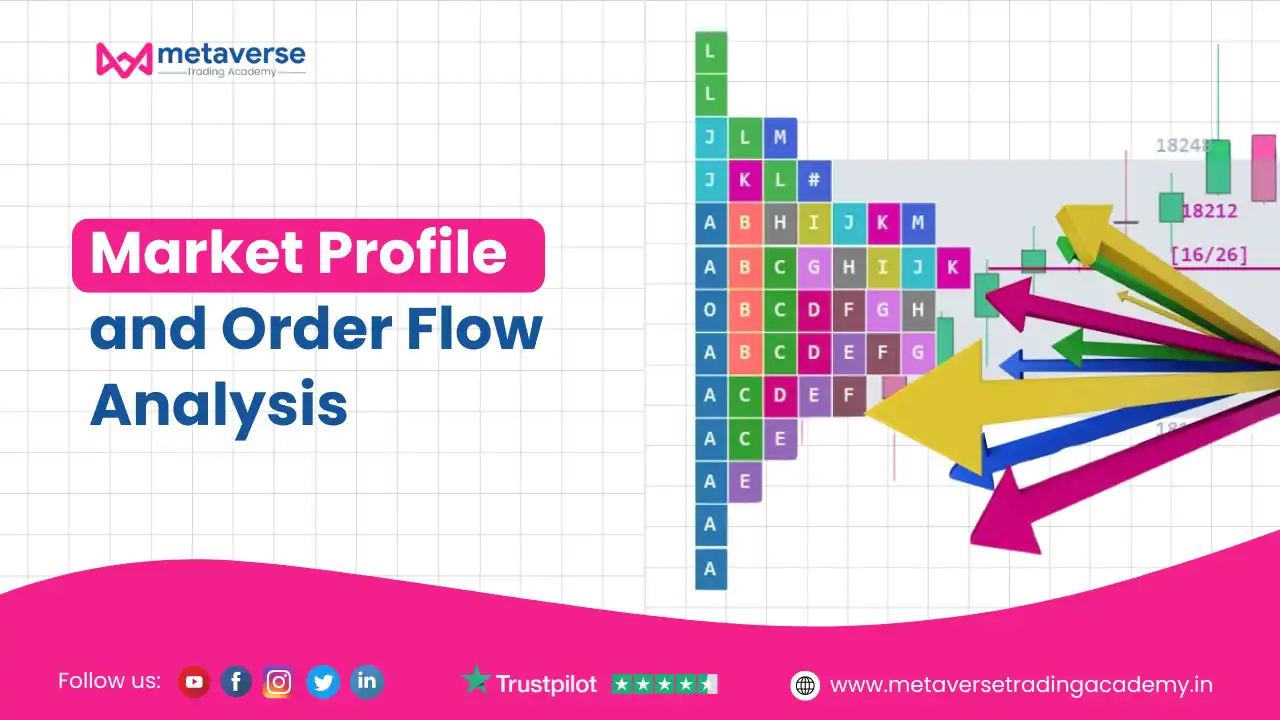
Market Profile and Order Flow Analysis: The 2026 Complete Trading Guide
Market Profile and Order Flow Analysis
Market Profile and Order Flow Analysis are the two most powerful tools professional traders use to read markets beyond basic candlestick charts. Market Profile reveals where price was accepted or rejected over time. Order Flow shows you in real time who is buying and who is selling and with how much aggression. When you combine both, you can identify high-probability trade setups that most retail traders cannot see.
This complete 2026 guide covers everything: TPO charts, Value Area, Point of Control, delta analysis, footprint charts, Initiative Buying and Selling setups, and real Nifty trade examples from beginner concepts to advanced integration strategies. By integrating these methods, traders can gain insights into both historical market activity and real-time order dynamics. This guide will delve into the key concepts, tools, techniques, and best practices for mastering Market Profile and Order Flow Analysis.
Market Profile is a charting technique developed by J. Peter Steidlmayer that organizes price data to show where time and volume were spent not just where price went. Unlike a candlestick chart, Market Profile answers two deeper questions: where did the market spend the most time (acceptance), and where did it reject price quickly (rejection)?
Key Elements of Market Profile:
Volume Profile: Displays the trading volume at various price levels, identifying zones of heavy activity (high volume nodes) and areas of low interest (low volume nodes).
High Volume Nodes (HVN): Suggest consolidation and price agreement.
Low Volume Nodes (LVN): Indicate rejection areas, often acting as breakout zones.
How to read a TPO (Time Price Opportunity) chart: Each letter on a Market Profile chart represents a 30-minute period. When many letters stack at a price level, it means the market spent a lot of time there that price was accepted. When only 1–2 letters appear at a level, price passed through quickly rejection. The bell curve shape that forms on a balanced day is one of the most reliable structures in all of technical analysis.
Value Area rule: 70% of the day’s volume trades within the Value Area. A common strategy used by professional traders is the “80% rule” if price opens inside the previous day’s Value Area and then moves outside it, there is an 80% probability it will return back inside. This is one of the highest-probability setups Market Profile generates.
Understanding Market Structure Before Using Market Profile
Market Profile is most effective when you first understand the market’s structural context. Market structure tells you who is in control buyers or sellers before you look at TPO patterns or volume nodes. Think of the market like a mountain hike. When price is in an uptrend, each new high faces less resistance (buyers dominating). When price is in a downtrend, each new low meets less support (sellers dominating). The transition between these states where buyers become exhausted or sellers give up is where Market Profile and Order Flow analysis give you the earliest possible warning signals.
Three market structure states to identify before reading Market Profile:
Trending market: Higher Highs and Higher Lows (uptrend) or Lower Highs and Lower Lows (downtrend). In trending markets, trade in the direction of the trend. Use Market Profile to find pullback entries at the Point of Control or Value Area Low (uptrend) or Value Area High (downtrend).
Balanced / range market: Price stays within a tight range with clear boundaries. The Market Profile will form a classic bell curve. Trade reversals at the extremes using Order Flow confirmation at VAH and VAL.
Transitioning market: When a previous trend shows buyer or seller exhaustion (delta divergence, shrinking delta spikes, price failing to make new extremes). This is the highest-probability setup for catching reversals. Markets rarely make V-shaped recoveries look for the U-shape base first.
India application: On a weekly Nifty chart, identify which structure phase you are in every Monday morning before marking your Value Area for the week. This single step eliminates more than half of false trade setups.
Understanding Order Flow Analysis
Order Flow Analysis provides real-time insights into market behaviour by examining buy and sell orders, their execution, and their impact on price movement. Unlike technical indicators, Order Flow tracks actual market dynamics, making it invaluable for short-term trading and scalping strategies.
Core Components:
Order Book: Shows active buy and sell orders at different price levels, providing insights into liquidity and market sentiment.
Footprint Charts: Visualize the number of contracts traded at each price level, revealing buying and selling pressure.
Delta Analysis: Tracks the difference between aggressive buyers (market orders lifting offers) and aggressive sellers (market orders hitting bids).
Integrating Market Profile and Order Flow for Superior Analysis
By combining the historical focus of Market Profile with the real-time precision of Order Flow, traders gain a well-rounded perspective. This approach enhances trade execution and decision-making by confirming trends, reversals, and breakout opportunities.
How They Complement Each Other:
Market Profile for Historical Context: Identifies key levels where price is likely to react, such as POC and Value Area High/Low.
Order Flow for Execution Precision: Tracks real-time buying and selling activity to confirm or negate the significance of these levels.
Advanced Trading Strategies
Initiative Buying and Initiative Selling — The Core Order Flow Trade Setup Initiative Buying (IB) and Initiative Selling (IS) are the two primary Order Flow trade setups used alongside Market Profile. Understanding these transforms how you enter and exit trades.
What is Initiative Selling (IS)?
Initiative Selling occurs when aggressive sellers step in and push price below a key Market Profile level typically below the Value Area Low, Point of Control, or a previous session’s low. This signals that sellers are taking initiative and a downtrend may follow.
IS Trade Setup: Wait for a bearish candle that closes below the key MP level with a surge in sell delta.
Activate the short trade: enter below the low of the IS candle.
Stop loss: above the high of the IS candle (or the key MP level).
Target: next significant support level often the previous week’s low or next Low Volume Node.
What is Initiative Buying (IB)?
Initiative Buying occurs when aggressive buyers push price above a key Market Profile level above the Value Area High, or a previous session’s high. This signals buyer momentum.
IB Trade Setup: Wait for a bullish candle that closes above the key MP level with positive delta surge.
Activate the long: enter above the high of the IB candle.
Stop loss: below the low of the IB candle.
Target: next resistance level. Next week’s POC or High Volume Node.
Nifty example: If Nifty’s session Value Area High is 22,620 and price breaks above it with a delta surge of +10,000 contracts on a 5-minute candle, an IB setup activates above 22,635.
Stop: 22,595.
Target: 22,750 (previous week’s VAH).
Risk-reward: approximately 1:2.8.
Always wait for activation never enter anticipating a breakout. Price must actually close beyond the key level first.
1. Reversal Trades at Key Levels
Setup: Mastering Market Profile to identify Value Area Low (VAL) or Value Area High (VAH) as potential reversal zones.
Execution: Use Order Flow to detect exhaustion patterns (e.g., aggressive selling diminishing near support).
2. Breakout Trades
Setup: Identify LVNs or price rejection zones using Market Profile.
Execution: Confirm breakout strength by monitoring aggressive orders through footprint charts and delta surges.
3. Trend Continuation
Setup: Use the Volume Profile to identify HVNs along a trending move.
Execution: Validate trend strength by observing consistent order flow momentum in the direction of the trend.
Tools and Software
Using Market Profile and Order Flow for Nifty and BankNifty Trading India’s derivative markets Nifty50 and BankNifty options and futures are among the most liquid in the world by contract volume. This makes them ideal candidates for Market Profile and Order Flow analysis.
Weekly Market Profile routine for Indian traders: Every Sunday evening, open Gocharting and pull up the weekly Market Profile for Nifty and BankNifty. Mark the following levels: Previous week’s Point of Control (POC) acts as the magnet price for Monday Value Area High (VAH) and Value Area Low (VAL) your bullish and bearish bias zones Previous week’s High and Low buy side and sell side liquidity zones On Monday morning, if Nifty opens within the previous week’s Value Area, apply the 80% rule: there is a high probability price returns to explore the full Value Area before making a directional move.
Expiry day (Thursday) Market Profile patterns: On weekly expiry day, Market Profile often forms a “P-shape” profile (long upper tail) or “b-shape” profile (long lower tail) in the first hour as institutions manage their option positions. A P-shape indicates early selling that was rejected bullish for the rest of the session. A b-shape indicates early buying that was rejected bearish.
Order Flow during Nifty open (9:15–9:30 AM): The first 15 minutes on NSE show the highest delta spikes of the day as opening orders clear. Do not react to the first 15-minute delta it is noise. Wait for the 9:30 AM candle to close before reading Order Flow direction. The delta shift from 9:30–9:45 AM is usually the most reliable directional signal of the morning session.
FII and DII Order Flow context: Download the NSE FII/DII daily report every morning before markets open. When FII are net buyers in index futures by more than 3,000 crore, the Order Flow tends to confirm bullish initiative buying during the session. When FII are net short above 5,000 crore, watch for Initiative Selling setups at VAH.
A variety of tools can facilitate Market Profile and Order Flow analysis:
Market Profile Tools:
Free and Paid:
Sierra Chart (Paid — $30/month) — Most customizable TPO and volume profile platform. Preferred by professional traders globally. Connects with NSE data via third-party providers.
Gocharting (Free + Paid) — The best option for Indian traders. Supports Nifty and BankNifty Market Profile natively with Indian broker integration (Zerodha, Upstox). Free tier includes volume profile and TPO charts.
TradingView (Free + Paid) — Has community volume profile indicators. Limited TPO support but accessible for beginners. Integrates with Zerodha Kite via Sensibull.
NinjaTrader (Free for analysis) — Excellent Market Profile modules. Primarily for futures traders. US-based but usable for CME/CBOT instruments.
For Nifty / BankNifty specifically: Gocharting is the recommended starting point. It shows daily, weekly, and monthly Market Profiles for all NSE instruments at no cost for basic features.
Order Flow Tools:
Free and Paid:
ATAS (AT Trading) (Paid — ~$50/month) — The most popular order flow platform among Indian professional traders. Shows delta, footprint charts, cumulative delta, and DOM. Connects with Zerodha, Upstox, and Angel One data via third-party bridges. Best choice for Nifty futures order flow.
Bookmap (Free + Paid) — Excellent for liquidity heatmap and DOM visualization. More commonly used for US futures and crypto, but supports NSE through data adapters.
Quantower (Free tier) — Combines footprint charts with advanced charting. Good free option for traders starting with order flow.
Gocharting (Free + Paid) — Has a basic footprint chart and delta display. The most accessible option for Indian retail traders on a budget.
Jigsaw Trading (Paid) — Specialized for DOM and tape reading. Preferred by scalpers in US futures markets.
Benefits of Mastering Market Profile and Order Flow
Enhanced Decision-Making: By combining past trends (Market Profile) and real-time data (Order Flow), traders can make informed decisions.
Solution: Use Market Profile for broader trends and Order Flow for intraday precision.
Case Studies: Success with Integrated Strategies
Reversal at POC
Nifty Futures (Real Example)
Market Profile Insight: On a Monday session, the Nifty 15-minute Market Profile showed a POC developing at 22,500. This level coincided with the previous week’s highest volume node — a strong confluence.
Order Flow Confirmation: As Nifty dipped below 22,500 in the first 30 minutes, delta on the footprint chart turned sharply positive. Aggressive buyers were absorbing every sell order — classic POC defense.
Initiative Buying (IB) Setup: The IB candle activated above 22,520. Stop loss placed below the wick at 22,485.
Target: Value Area High at 22,650.
Outcome: Nifty moved 130 points to the target within 90 minutes. Risk-reward achieved: 1:3.7.
Breakout Failure
BankNifty Expiry Trade
Market Profile Insight: BankNifty’s weekly profile showed a Low Volume Node (LVN) between 48,200 and 48,350 — a thin area where price moves fast if broken.
Order Flow Confirmation: During the first hour of Thursday expiry, BankNifty broke above 48,350 with a large delta spike of +8,400 contracts. However, price failed to hold above this level for more than 2 candles, and delta then collapsed to −6,200 — a classic failed breakout absorption signal.
Initiative Selling (IS) Setup: Short below the IS candle low at 48,290. Stop loss above the breakout wick at 48,410.
Target: 48,000 (VAL of the session profile).
Outcome: Price fell 300 points to target within 45 minutes. Risk-reward: 1:2.5.
FAQ’s
What is the difference between Market Profile and Order Flow analysis?
Market Profile organizes historical price and volume data to show where time was spent at each price level — it gives you a map of past market structure. Order Flow analysis reads live buy and sell orders in real time to show current market aggression. Market Profile tells you where to look; Order Flow tells you what is happening there right now.
Can beginners use Market Profile and Order Flow analysis?
Yes, but with a learning curve. Beginners should start with Market Profile — specifically learning to identify Value Area, Point of Control, and High/Low Volume Nodes. Order Flow tools like footprint charts and delta should be added only after Market Profile basics are solid. Rushing into both simultaneously leads to analysis paralysis.
What is the best platform for Market Profile and Order Flow in India?
For Indian traders using Nifty and BankNifty, Gocharting is the best free option for Market Profile. For Order Flow, ATAS is the most widely used professional platform that supports NSE data feeds. TradingView is a good starting point for volume profile before upgrading to dedicated platforms.
What is the Point of Control (POC) and how do you trade it?
The Point of Control is the price level with the highest volume traded in a given session or period. It acts as a magnet — price frequently returns to test the POC before making its next directional move. A common trade is to fade price extremes when they move more than 1 Average True Range away from the POC, using Order Flow confirmation at the extreme level before entry.
What is delta in Order Flow analysis?
Delta is the difference between aggressive buying volume (market orders hitting the ask) and aggressive selling volume (market orders hitting the bid). Positive delta means buyers are more aggressive. Negative delta means sellers dominate. Delta divergence — where price moves in one direction but delta moves in the opposite — is one of the most reliable early reversal signals in Order Flow trading.
Conclusion
Mastering Market Profile and Order Flow analysis transforms how traders approach the financial markets. While Market Profile provides a historical roadmap of price behavior, Order Flow offers real-time insight into ongoing market dynamics. Together, they form a robust strategy that boosts trading precision and profitability.
To excel, traders must remain disciplined, practice regularly, and leverage advanced tools. By integrating these techniques, traders can navigate the complexities of financial markets with confidence and clarity.
NISM-certified trader, technical analyst, and founder of Metaverse Trading Academy. With more than 10 years of experience in stock market trading and technical analysis, I have trained over 10,000 students across India through online and offline trading programs focused on intraday trading, swing trading, futures & options, and risk management.