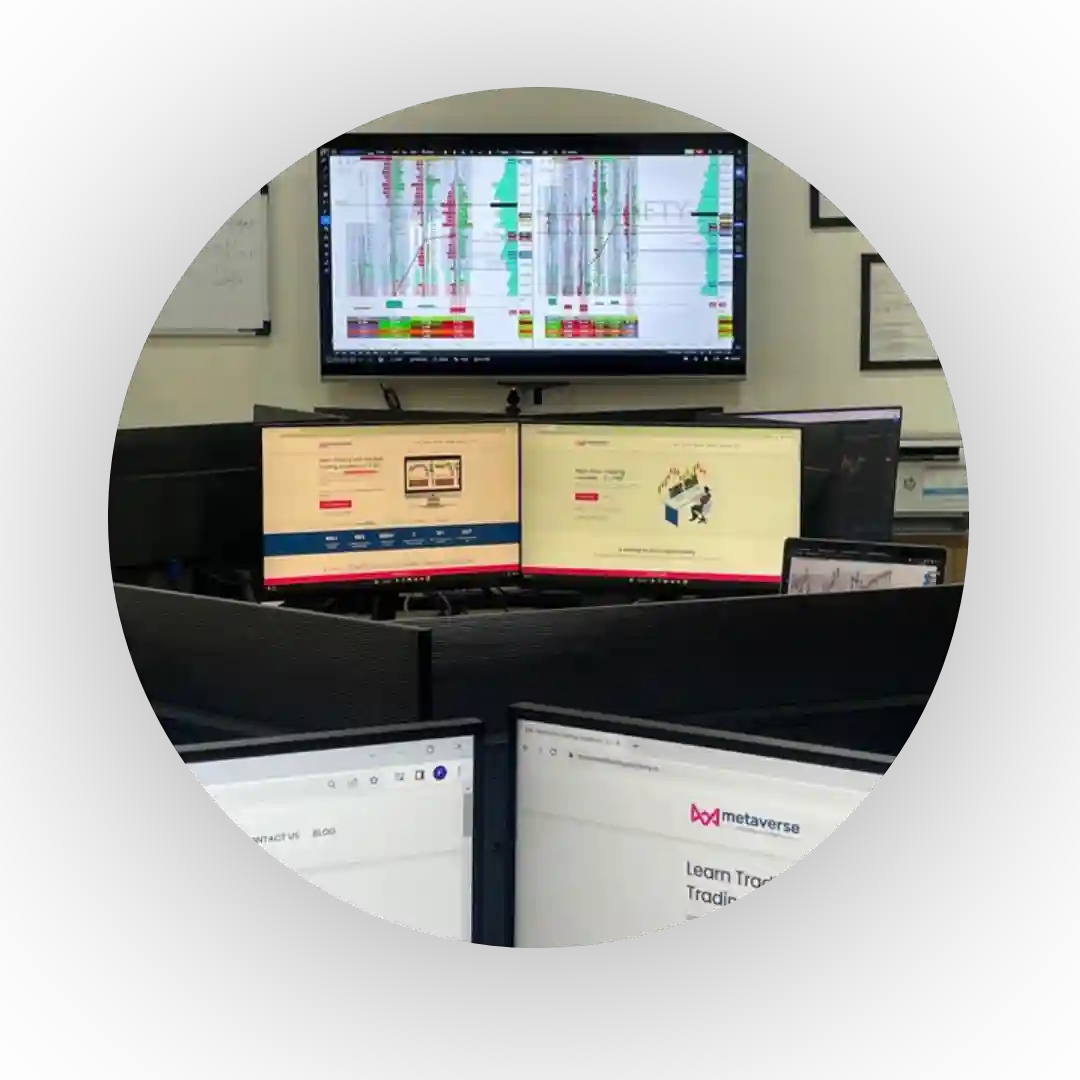
Metaverse Trading Academy is best trading academy in india to learn stock trading using order flow, market profile, volume profile, option chain etc.
Rajkot, Gujarat, India


Institutional order flow is the hidden force that truly drives financial markets. While retail traders often rely on indicators, patterns, and signals, professional institutions move price through massive capital deployment and strategic execution.
In Indian markets like NSE and BSE, understanding institutional order flow helps traders decode why price reacts at certain levels, why fake breakouts occur, and why trends sustain longer than expected. This shift in perspective is similar to understanding the difference between trading and investing—it changes how traders approach markets at a structural level.
This guide explains how big players trade, how institutional order flow shapes market structure, and how retail traders can align with smart money instead of trading against it.
Institutional order flow refers to the buying and selling activity generated by large financial institutions such as mutual funds, banks, hedge funds, FIIs, DIIs, and proprietary trading desks.
Unlike retail traders, institutions deal with extremely large order sizes. They cannot enter or exit trades instantly without impacting price. As a result, their orders are executed strategically over time and across key price levels.
Key features of institutional order flow include:
At its core, institutional order flow represents the real demand and supply behind price movement.

Markets move when there is an imbalance between buyers and sellers. While retail traders add volume, institutions create direction.
When institutional order flow enters the market, price behavior changes noticeably:
This is why trends often begin quietly and accelerate suddenly. Institutions build positions patiently and release price aggressively once positioned.
In India, institutional order flow mainly comes from a few dominant participants.
Major institutional players include:
Tracking institutional activity through FII/DII data often provides early clues about broader market sentiment.

A common misconception is that institutions place single massive orders. In reality, institutional order flow is carefully engineered to minimize market impact.
Institutions use advanced execution techniques such as:
These techniques leave subtle footprints on price charts that experienced traders can learn to identify.
Market structure is a direct outcome of institutional order flow. Concepts like BOS and CHoCH become far more powerful when combined with volume-based context, as discussed in mastering market profile and order flow.
When institutions change bias, market structure reacts first.
Key structure concepts driven by institutional order flow include:
Retail traders who understand structure stop chasing indicators and start reading intent.

Order blocks are zones where institutions placed significant buy or sell orders before a major price move.
These zones often act as future support or resistance because institutions defend their positions.
Characteristics of institutional order blocks include:
Order blocks are one of the clearest visual representations of institutional order flow. Traders who want deeper clarity on how order blocks differ from traditional concepts can explore order block vs order flow trading strategy – smart money concepts.

Institutions require liquidity to execute large orders. Liquidity usually sits above highs and below lows where retail stop-losses accumulate. Learning how to spot these areas is essential, which is explained in detail in our guide on how to identify liquidity zones and trade liquidity concepts.
This is why markets often:
These moves are not random. They are liquidity-driven actions linked directly to institutional order flow.
When institutions execute aggressively, price moves faster than liquidity can fill, creating inefficiencies called fair value gaps (FVGs).
Fair value gaps represent price imbalance zones where institutions may later rebalance orders.
Key traits of fair value gaps include:
Combining FVGs with market structure improves trade accuracy significantly.
Retail traders and institutions approach markets very differently.
Key differences include:
Understanding this difference helps traders avoid common traps and align with smart money behavior.

Retail traders cannot match institutional size, but they can follow institutional intent.
Practical ways to align with institutional order flow include:
Retail traders often struggle because of emotional decision-making and impulsive trades. Aligning with institutional order flow also requires fixing behavioral issues, which are commonly covered in why most traders fail and how to avoid common pitfalls.
There are many misconceptions around institutional trading.
Some common myths include:
In reality, institutional order flow concepts are visible on simple price charts when understood correctly.
Index instruments like Nifty and Bank Nifty are heavily influenced by institutional order flow.
Institutions use indices to:
This is why index charts often respect structure, order blocks, and liquidity zones more cleanly than individual stocks.

What is institutional order flow in trading?
Institutional order flow refers to buying and selling activity of large financial institutions that drive market direction through volume and liquidity.
How can retail traders identify institutional order flow?
Retail traders can identify institutional order flow using market structure, order blocks, liquidity zones, and fair value gaps.
Does institutional order flow work in Indian markets?
Yes, institutional order flow is highly effective in Indian markets like NSE and BSE, especially in indices and liquid stocks.
Is institutional order flow better than indicators?
Institutional order flow focuses on price behavior and intent, while indicators are lagging tools derived from price.
Do I need advanced data to trade institutional order flow?
No, institutional order flow concepts can be applied using simple price charts and volume analysis.
Which instruments show clear institutional order flow?
Index futures, Bank Nifty, Nifty, and large-cap stocks show the clearest institutional order flow behavior.
Institutional order flow is the foundation of how markets truly operate. Price does not move randomly—it moves because large players deploy capital strategically around liquidity and structure.
By learning to read institutional order flow, traders stop reacting emotionally and start understanding intent. This shift transforms trading from guesswork into structured decision-making.
At Metaverse Trading Academy, we focus on helping traders decode smart money behavior, build discipline, and trade with confidence in India’s evolving markets.
Metaverse Trading Academy empowers traders with AI-driven education, trading psychology insights, and practical investment strategies for India’s evolving market.
Learn more at https://metaversetradingacademy.in


Disclaimer: Investing/Trading in the stock market is subject to market risks, and there is no assurance or guarantee of returns—neither the principal nor the appreciation of the investments. The content/education provided by the institute, mentors, or their assigns is solely for general interest, educational purposes, and the reader’s information. All participants are requested to seek independent expert opinions before acting on anything mentioned in this course/program. We are not liable or responsible for any decisions made by the participant solely based on the information provided here. All information/views/opinions in the course/program are our interpretation, and we cannot be held responsible for any miscommunication, misinformation, or any actions taken by an individual or group based on the course/program. By enrolling and accessing the program/course, you accept the “Disclaimer,” without limitation or qualification. Upon viewing this disclaimer, you understand and acknowledge that there is a very high degree of risk involved if the information is misinterpreted. As stipulated by law, the institute cannot and does not make any guarantees about your ability to get results or earn money with ideas, information, tools, or strategies from the course/program. The participant should know that all the ideas, information, tools, or strategies shared during the course/program are for educational and informational purposes only. Asmita Patel Global School of Trading, Asmita Patel, and her team are neither responsible nor liable for any losses resulting from investments. You alone are responsible and accountable for your decisions, actions, and results in life. By registering here, you agree not to attempt to hold us liable for your decisions, actions, or results, at any time, under any circumstance.